
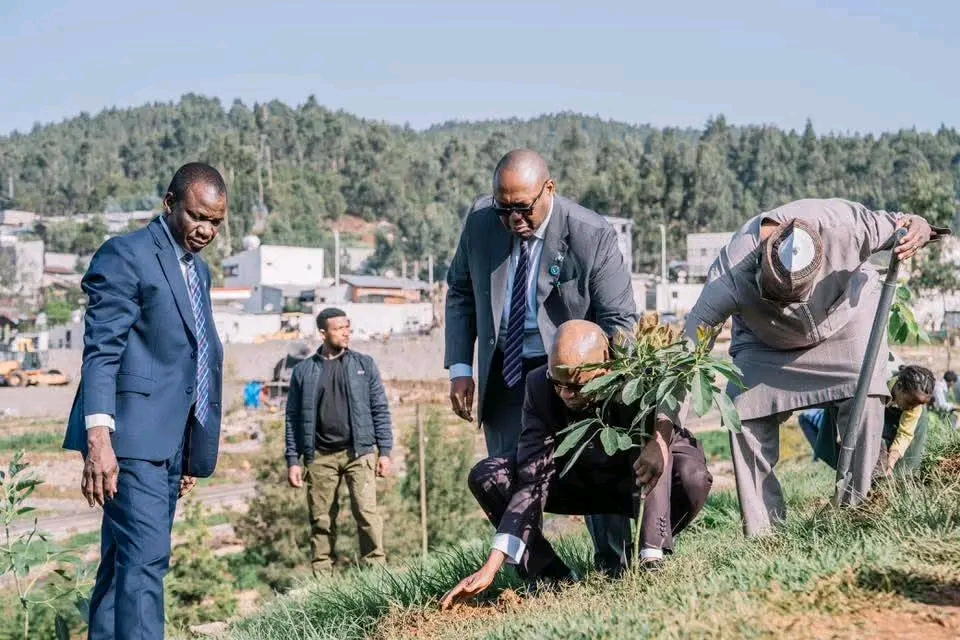
Vice-President Kashim Shettima says Nigeria is working towards food independence through mechanised farming, climate-smart agriculture, improved seeds and modern farming methods.
He also announced plans to plant 20 billion trees starting from the next rainy season, following lessons from Ethiopia’s Green Legacy Initiative, which links environmental recovery with economic growth and better livelihoods.
Speaking during a visit to farms and agricultural facilities in Oromia, Ethiopia, Shettima said the tree-planting drive would need careful planning, strong commitment and public support.
“We will embark on a massive tree-planting campaign in the next rainy season, and we intend to plant 20 billion trees,” Mr Shettima stated. “It requires a lot of planning, energy and drive, which Ethiopia was able to galvanise its population into doing.”
He stressed that food production was central to national independence, warning that reliance on food from other countries could weaken a nation’s sovereignty.
“Food dependency compromises our sovereignty. Without independence in food production, a nation remains incomplete in its sovereignty,” he said.
Shettima described Ethiopia’s agricultural progress as an example Nigeria and other African countries could follow. He called for stronger cooperation between Nigeria and Ethiopia to improve food security and help Africa feed itself.
“Africa must learn to feed itself. Ethiopia is doing it, and Nigeria is on course to do the same. Ethiopia is a success story worthy of emulation,” he said.
He added that Ethiopia’s achievements could benefit the wider continent, noting that the two countries’ combined population exceeds 400 million.
“With a population of 100 million people, and a combined population with Nigeria of over 400 million, Ethiopia’s success will reverberate across the length and breadth of East and Southern Africa,” he said.
