
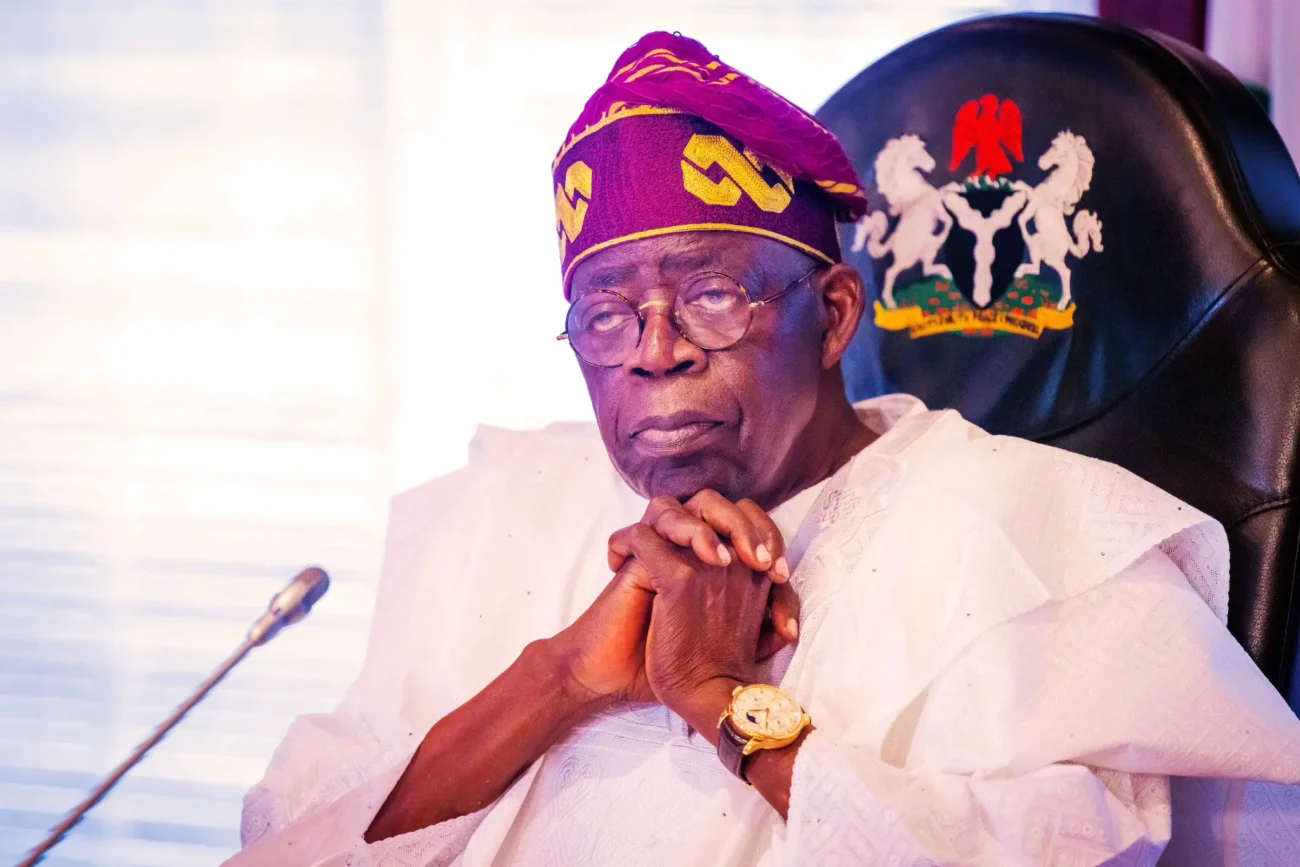
President of Nigeria 2023 – 2027
Bola Ahmed Tinubu
Bola Tinubu, often referred to as the “Godfather of Lagos” and a key founder of Nigeria’s ruling All Progressives Congress (APC) is the country’s President.
He is praised by admirers as a visionary who transformed Lagos State’s economy and governance, and called out by critics as a typical godfather who has built a vast, corrupt political empire.
His presidency, which began in 2023, has been defined by bold, biting economic reforms.
Biography
- Full name: Bola Ahmed Adekunle Tinubu, popularly “Jagaban” (a Hausa chieftaincy title meaning roughly “war chief”/commander), also “Asiwaju” (Yoruba for leader).
- Born: March 29, 1952, Lagos, Nigeria (some biographers and critics dispute this date). Currently 74 years old.
- Education: Richard J. Daley College (Chicago), then a BSc in accounting from Chicago State University (CSU) -graduated 1979.
- Became a chartered accountant, worked at Deloitte, Haskins & Sells, then rose to a senior treasurer/executive role at Mobil Oil Nigeria in the 1980s.
- Party: All Progressives Congress (APC), which he co-founded in 2013 by merging several opposition parties to unseat the Peoples Democratic Party (PDP).
Political History
- 1992–93: Bola Tinubu was Senator for Lagos West under the Social Democratic Party, during the transition period before the Abacha coup cancelled Nigeria’s democratic government. Went into exile during Abacha’s dictatorship (1994–98), part of NADECO, the pro-democracy opposition movement -this is a credential he leans on heavily.
- 1999–2007: Governor of Lagos State (two terms), under the Alliance for Democracy then Action Congress. This is the foundation of his legend: he’s widely credited with modernizing Lagos’s IRS (dramatically boosting internally generated revenue independent of federal allocation), starting the BRT bus system, and building the political-machine template -patronage networks, godfatherism, and a stable of protégés -that he later exported nationally. Babatunde Fashola, Akinwunmi Ambode, and Babajide Sanwo-Olu all succeeded him as Lagos governor as his anointed candidates.
- 2013: Chief architect of the APC merger -this is recognized as his single most consequential political act pre-presidency.
He assembled the coalition (ACN, CPC, ANPP, a PDP faction) that unseated Goodluck Jonathan’s PDP in 2015, running Muhammadu Buhari as the electable northern face while Tinubu built the machine and reportedly bankrolled/organized much of the campaign. He never got a major cabinet post under Buhari (widely read as Buhari and his inner circle sidelining him), which fed years of “when is it my turn” tension inside APC.
- 2023: Won the presidential election on the APC ticket with about 37% of the vote in a 4-way contest against Atiku Abubakar (PDP), Peter Obi (Labour Party, who captured the “Obidient” youth/urban reform vote) and Rabiu Kwankwaso who get most of the votes from Nigeria’s Muslim Kano state.
Turnout was historically low (~27%). The result was challenged at the Supreme Court by both Atiku and Obi over irregularities and INEC’s failure to transmit results electronically as promised -the Court upheld Tinubu’s win in October 2023.
Policy record as president (2023–present)
The two headline moves, both immediate and brutal in effect:
- Fuel subsidy removal -announced literally in his inauguration speech, May 29, 2023 (“subsidy is gone”). This ended a decades-long, massively expensive petrol subsidy (his own government cites it as costing ₦18.4 billion/day, over ₦4 trillion in 2022 alone).
Petrol prices went up 500% immediately throughout Nigeria. This is the single most consequential and most economically painful policy of his presidency.
- Naira float/unification – collapsed the multiple official exchange-rate windows into a managed float shortly after taking office, ending a huge arbitrage/rent-seeking racket but triggering a currency collapse – the naira lost well over half its value against the dollar, driving inflation into the 30%+ range for extended periods and crushing real incomes.
Effects and follow-on: Both moves are unpopular but arguably necessary macroeconomic medicine – they were long recommended by the IMF/World Bank and most serious Nigerian economists as unsustainable to maintain.
But the sequencing (both at once, with weak simultaneous social safety-net rollout) produced a severe near-term cost-of-living crisis: fuel/transport costs spiked, food inflation surged, and real wages collapsed.
The administration’s own framing (as of the 2026 third-anniversary address) is that this was the courageous, necessary path and that fiscal indicators are now stabilizing – that’s a genuinely contested claim; critics say the pain has been disproportionate and the relief measures (cash transfers, CNG conversion buses, student loans, minimum wage increases) have been slow, patchy, or poorly targeted.
Other notable facts:
- Tax reform – a major overhaul pushed through the National Assembly in 2025, restructuring federal/state revenue sharing and consolidating multiple tax agencies; Taiwo Oyedele has been central to this and was elevated to substantive Finance Minister in 2026.
- Security -mixed record. There have been real wins (e.g., a July 2026 rescue of children/teachers abducted by Ansaru terrorists in Oyo State without ransom, which the administration touted heavily), but banditry, kidnapping, and Boko Haram/ISWAP remnant activity in the northeast and northwest remain serious, chronic problems that haven’t been resolved.
- Foreign policy – active courting of Arab states (UAE), Turkey, and African trade integration (hosting AfCFTA forums), positioning Nigeria as a bigger continental economic player.
- Declared 2026 the “Year of Social Development and Families,” pushing a large women/family-focused welfare program (targeting 25 million women) -this is fairly fresh and its actual delivery is still unproven.
- Governance style: heavy use of political patronage, a large and frequently reshuffled cabinet, and a reputation (going back to Lagos) for building intensely loyal, machine-style political structures rather than institutional ones.
Family
- Wife: Senator Oluremi Tinubu (married 1987), former Senator for Lagos Central (2011–2023), now Nigeria’s First Lady. A pastor in the Redeemed Christian Church of God. Tinubu is Muslim; his household is famously interfaith, and his children were raised Christian.
Children: Six total, from multiple relationships predating and alongside his marriage to Remi:
- Folashade Tinubu-Ojo -businesswoman, holds the traditional Lagos market title “Iyaloja-General.”
- Seyi Tinubu -his only surviving son, co-founded an out-of-home media/advertising agency (Loatsad Promomedia), runs the Noella Foundation, and has become an increasingly visible and controversial political operator (accused by critics of running a shadow “youth” power structure and enjoying outsized, unofficial influence despite holding no formal office).
- Jide Tinubu – died October 2017 in London of respiratory illness.
- Zainab Abisola, Habibat, and Yinka Tinubu -Remi’s biological children; one, Abibat, is a Berklee-trained musician/medical-adjacent professional depending on the source.
- Tinubu is a grandfather several times over through Jide, Seyi, and Folashade.
Controversies About Bola Tinubu
Identity, age, and academic record. This is the longest-running and most persistent controversy of his career. Questions have circulated for over two decades about: his real age/date of birth, whether “Bola Tinubu” fully accounts for his identity, and the authenticity of his Chicago State University degree/records.
CSU itself had to issue a statement affirming he graduated, after inconsistencies in submitted records became a legal issue during his 2022–23 campaign. None of this has ever been definitively resolved to the satisfaction of critics, and it remains a live rhetorical weapon against him.
1993 US asset forfeiture case. In 1993, Tinubu forfeited $460,000 to the US government in a civil case connected to a narcotics-trafficking investigation (he was not criminally charged; the money was in accounts tied to alleged drug proceeds). This resurfaces constantly in Nigerian political discourse as a corruption/drug-money stain.
2020 Lekki Toll Gate shooting. During the #EndSARS protests, soldiers opened fire on protesters at the Lekki toll gate in Lagos -Tinubu was Lagos’s political godfather at the time (not governor) but was widely believed by protesters to have influence over the state response.
No direct evidence has ever tied him personally to the shooting order, and he’s denied involvement, but it remains a lasting stain associated with his name in the #EndSARS generation’s memory. (A viral claim that OCCRP ranked him the “third most corrupt person in the world” was fact-checked as false/misleading -it distorted a nomination-based “Person of the Year” list.)
2026 budget corruption allegations. Ongoing as of mid-2026: opposition figures (Peter Obi, activist Timi Frank) have alleged the 2026 federal budget contains inflated allocations and “fictitious projects,” and separately that ₦8.83 trillion in 2025 spending wasn’t captured in the budget at all (a claim attributed to an IMF consultation report).
There’s also an active controversy around his Chief of Staff, Femi Gbajabiamila, over alleged influence-peddling and questionable agency allocations tied to the 2026 Appropriation Act. These are serious, live allegations -not adjudicated -and the presidency has largely not responded publicly to the specifics.
Party-loyalty machine politics. APC figures facing serious allegations (e.g., former party chairman Abdullahi Ganduje facing a 10-count fraud charge in Kano over a port-shares transfer; Budget Minister Abubakar Bagudu’s historical links to Abacha-era embezzlement networks flagged by the US Department of Justice) have stayed inside the tent and publicly reaffirmed loyalty to Tinubu rather than facing consequences – critics see this as evidence the anti-corruption rhetoric is selective/political rather than principled.
Positives generally given by his admirers
- Genuine economic reforms (subsidy removal, FX unification, tax reform) that most independent economists agree were overdue, even if the execution and social cushioning were criticized.
- Proven administrative competence at the state level in Lagos -revenue generation and infrastructure delivery there is a real, checkable record, not just mythology.
- Effective coalition-builder and political strategist – the 2013 APC merger and 2015 win are legitimate, significant achievements in Nigerian political history.
- Genuine pro-democracy credentials from the NADECO/exile period.
