
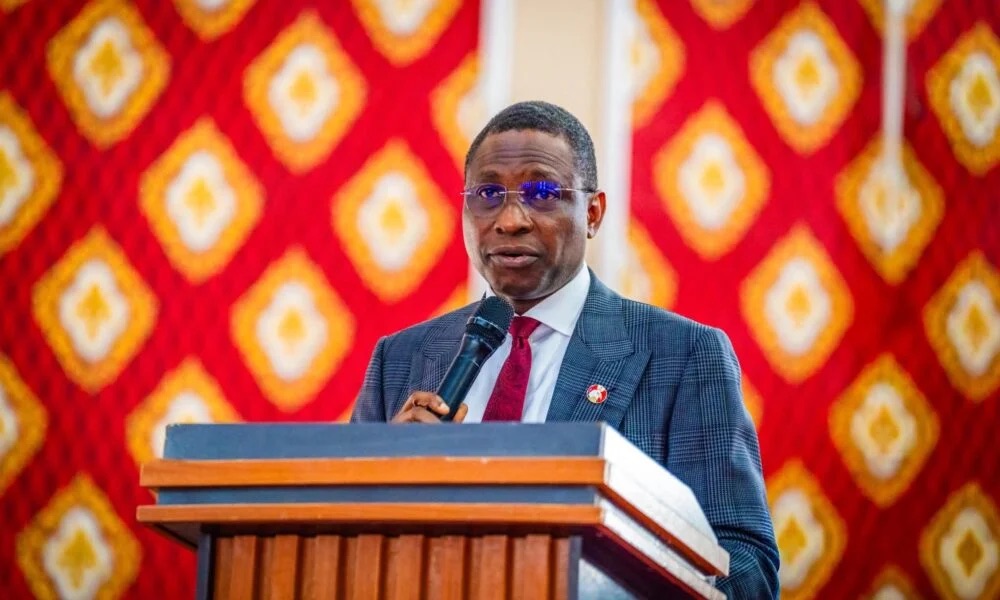
The Chairman of the Economic and Financial Crimes Commission (EFCC), Ola Olukoyede, has revealed that a private university recently forfeited to the Federal Government has a vice-chancellor’s lodge that is probably bigger than President Bola Tinubu’s official residence at the Aso Rock Villa.
In a video posted on his official X account on Friday, September 4, Olukoyede said recovered crime assets are now being converted for public use.
He cited NOK University in Kachia, Kaduna State, which was forfeited and turned into the Federal University of Applied Sciences, Kachia (FUASK). He said 1,909 students matriculated there in December 2025 and noted that the institution is expected to boost Southern Kaduna’s local economy.
Olukoyede also disclosed that another “high value” private university had been finally forfeited.
“You need to get to that university. It has temporary site and permanent site. The house that was built for the vice-chancellor alone is probably bigger than the president’s house in the villa. The picture is all over the place. If you Google it now, you will see the pictures,” he stated.
He did not name the school, but reports and EFCC filings link it to Rayhaan University in Kebbi State, whose sites, radio station and vice-chancellor’s residence were covered by a July 15, 2026 final forfeiture order. The properties were linked to former Attorney-General of the Federation, Abubakar Malami, SAN.
Olukoyede said the EFCC secured interim or final forfeiture of 10,053 assets between October 2023 and July 2026, including real estate, schools, factories, hotels, aircraft and 102 tonnes of solid minerals.
Disposals from final forfeitures returned ₦12.07 billion to the Federal Government. The EFCC also recovered ₦1.233 trillion and secured 10,872 convictions during the period.
He said, “Taken together, these outcomes tell a larger story. Anti-corruption enforcement can restore physical space, strengthen federal and sub-national revenue, return working capital to institutions, companies and citizens, support financial market integrity, protect the extractive and digital economies, and strengthen Nigeria’s international credibility.
“It also produces a deterrence dividend: every successful every successful prosecution and every asset stripped from criminal enterprise reduces the cost of economic crime.”
