
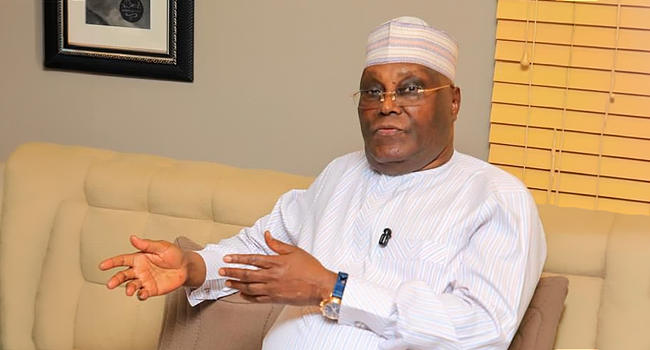
Former Vice-President Atiku Abubakar has accused the APC Presidential Campaign Council of trying to cover up President Bola Tinubu’s “unfulfilled electricity promise with a long recital of laws, committees, bonds and projects”.
Atiku, in a statement released by Phrank Shaibu, Director of Strategic Communication of the ADC Presidential Campaign Council, said Nigerians were still struggling with poor electricity despite the promises made by Tinubu.
He said families, traders and small business owners were spending more money on alternative power while receiving electricity bills for services they could not depend on.
“The APC should spare Nigerians the spectacle of celebrating paperwork while homes and businesses remain in darkness. After three and a half years, families still struggle to keep their homes lit. Traders and small business owners spend scarce resources on alternative power, yet struggle to keep their businesses alive. Nigerians are billed for electricity they cannot rely on. President Tinubu promised steady power and an end to estimated billing. That promise has not been kept.
Atiku also questioned the different electricity charges under Bands A, B, C, D and E, noting that Band A customers in many areas pay about ₦209.50 per unit before VAT.
He further demanded clarity on the planned removal of electricity subsidies from 2027 and what it would mean for consumers’ bills.
He promised to work with state governments and regulators to scrap the current band system and introduce a fairer, affordable arrangement that would hold electricity companies accountable.
“When President Tinubu campaigned in 2022, he made an unmistakable commitment. He said: ‘If I don’t give you constant electricity for four years, when I come back for a second term, don’t vote for me.’ Nigerians have lived through those four years. They do not need his campaign council to interpret his words for them. They need him to answer for them.
He also accused Tinubu’s administration of failing to build new power generation infrastructure, despite introducing a multitrillion-naira bond programme to settle debts owed to generation companies.
Atiku questioned the impact of the programme, adding that paying old debts was not the same as building new power facilities.
He also raised concerns about VAT on electricity and the proposed five per cent surcharge on certain fossil fuels, including petrol and diesel, under the Nigeria Tax Act.
Although the government said the surcharge had not been activated and would require a ministerial order, Atiku said Nigerians deserved to know why another possible charge was being considered.
He concluded by saying that laws, bonds and approved projects could not replace actual electricity, insisting that Nigerians wanted reliable and affordable power from a government that keeps its promises.
