
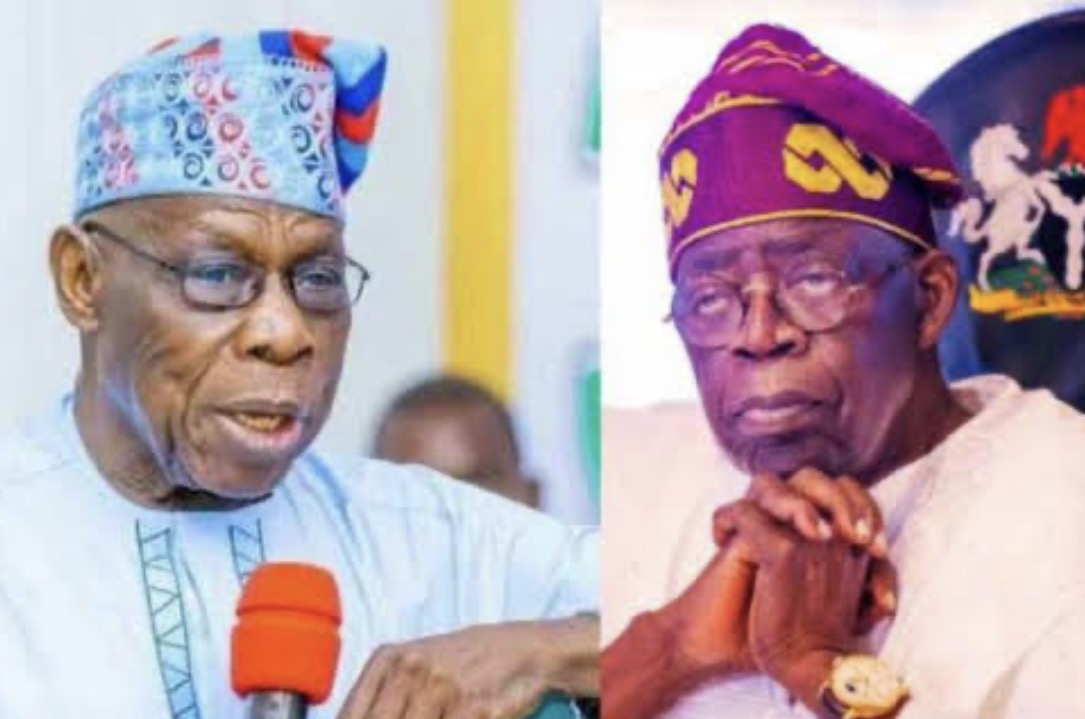
Former President Olusegun Obasanjo has attacked President Bola Tinubu’s position on government borrowing, describing his claim that borrowing is not leprosy as “absolute nonsense”.
Obasanjo argued that Nigeria’s growing debt burden was more dangerous than leprosy because its consequences could affect several generations.
He made the remarks on Friday in Abeokuta, Ogun State, during the Ajibosin Platform, a public forum themed “Leveraging Artificial Intelligence to solve grassroots problems and accelerate National Development.”
His criticism followed Tinubu’s statement in April that his government would continue borrowing whenever necessary, as long as efforts were made to repay the loans.
Tinubu had made the statement at the State House during a meeting with leaders from Plateau State, including Governor Caleb Mutfwang and the National Chairman of the All Progressives Congress (APC), Nentawe Yilwatda.
“If we have to borrow, we borrow. Borrowing is not leprosy, we just have to work hard to be able to pay for it,” the president had said.
The President’s position came at a time when Nigerians were raising concerns about the country’s increasing debt and the growing amount of government revenue being used to repay loans.
However, Obasanjo strongly disagreed, arguing that the damage caused by debt could last far longer than the suffering caused by leprosy.
“And for anybody to say debt is no leprosy, is absolute nonsense. Debt is worse than leprosy. Because leprosy destroys only one person. Debt destroys generations.”
The former president also raised questions about Nigeria’s economic direction, pointing to the sharp fall in the value of the naira over the past 47 years.
He recalled that when he established his farm, one naira was worth $1.85, compared with the current exchange rate of about N1,500 to one dollar.
“When I started my farm, 47 years ago, naira to the dollar was one naira to $1.85. Forty-seven years ago. What has Nigeria done in 47 years that we now have 1,500 naira to the dollar? What have we done?” he asked.
Obasanjo questioned whether Nigeria’s political leaders had the knowledge and ability needed to make decisions that would improve the lives of citizens.
“What do our leaders know? And what do they not know? And from what they know, what can they do for us?” he asked.
He also criticised Nigeria’s heavy reliance on foreign financial institutions, particularly the World Bank and the International Monetary Fund (IMF).
According to him, the policies recommended by these institutions do not always reflect Nigeria’s economic needs and challenges.
Obasanjo recalled that Nigeria had previously been discouraged from providing agricultural subsidies, even though farmers in developed countries enjoyed government support.
“World Bank and IMF were not designed for us. They were not built by us. They were built before we became independent. And that’s the people who would determine what we do,” he said.
He further cautioned Nigerian leaders against accepting economic advice from experts trained abroad without first considering the country’s unique circumstances.
