
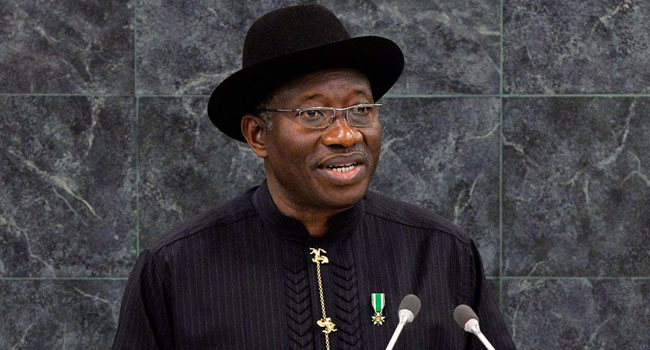
Former President Goodluck Jonathan has raised concerns over the growing cases of political intolerance and violence ahead of Nigeria’s 2027 general elections, warning that some political parties now run their campaign teams like cult groups.
Jonathan spoke on Tuesday, November 17, in Abuja during a peace and security conference organised by the Goodluck Jonathan Foundation. The conference was themed “Safeguarding Peace and Strengthening Social Cohesion in a Competitive Political Environment”.
He said concerns about Nigeria’s political direction were growing, adding that he had received calls from Nigerians and people in other countries who were worried about the situation.
“As we gradually approach the 2027 general elections, certain developments in our political environment are becoming increasingly worrisome,” he said. “As a former president, I receive calls from Nigerians and friends of our country across the world who express concern about the direction Nigeria is heading.”
The former president said many Nigerians were becoming worried about possible violence and crises after the elections instead of feeling confident about the country’s democratic future.
“Rather than the confidence and optimism we should be inspiring, there is growing apprehension about the likelihood of crises that may follow the elections. We must not ignore these concerns,” Jonathan said.
He identified political intolerance as one of the major problems facing the country, accusing some politicians of refusing to accept opposing views or respect the rights of others to contest for public office.
Jonathan also condemned the use of young people to carry out political violence and other acts of thuggery.
“This is compounded by political thuggery, the exploitation of our young people as instruments of violence, and acts of political brigandage,” he said. “It’s becoming obvious. We are running political organisations — campaign teams as cult groups.”
Jonathan also raised concerns about conflicting court rulings, especially decisions delivered by courts of equal jurisdiction on similar matters.
He warned that such judgments could damage public trust in the judiciary and increase political tension.
“While the judiciary has the constitutional responsibility to interpret the law and adjudicate disputes, conflicting decisions on similar matters can undermine public confidence in the institution and create unnecessary tension,” he said. “We must protect the integrity and independence of our judiciary. When citizens begin to lose faith in the courts and resort to self-help, the consequences can be disastrous. The descent from a loss of confidence in institutions to anarchy is a danger we must collectively prevent.”
The former president further cautioned political leaders against using elections to encourage ethnic divisions and rivalry across the country.
“Nothing could be more dangerous to our national existence than the deliberate encouragement of ethnic rivalry,” Jonathan said. “We must never allow political ambition to undermine the bonds that hold us together as one nation and in our states.”
He urged Nigerians to consider the competence and credibility of candidates rather than allowing ethnic, religious or other personal interests to influence their choice of leaders.
Referring to comments he recently made in Lagos, Jonathan said Nigeria needed to rethink the way people were selected for public office.
“Our present system remains vulnerable to ethnic, religious and other primordial considerations, which often prevent competent and credible individuals from emerging as leaders,” he said.
He also called on voters to pay closer attention to the quality of candidates seeking political offices at both the federal and state levels, noting that their choices would shape the country’s future.
“Let us choose competence over prejudice, service over personal ambition, and national interest over narrow considerations,” he said. “Our democracy must produce leaders capable of uniting our people and advancing our collective development.”
Meanwhile, former President of the ECOWAS Commission, Omar Touray, who delivered the keynote address, said the 2027 elections presented Nigeria with an opportunity to prove that a large and diverse country could strengthen democracy without losing its unity.
Touray noted that Nigeria’s population, economic influence, diplomatic weight and strategic position made its electoral process important beyond the country’s borders.
“A peaceful, transparent and credible electoral process in Nigeria would reinforce confidence in democratic governance across the continent,” Touray said.
He also described Jonathan’s decision to accept defeat before the final results of the 2015 presidential election were announced as an “enduring example of democratic statesmanship”.
Former Vice-President Namadi Sambo also spoke at the conference, stressing that democracy could only thrive when there was trust, mutual respect, strong institutions and public confidence in the political process.
Sambo said political competition was necessary for democracy but warned that it must not be allowed to weaken public institutions, damage the shared identity of Nigerians or threaten the country’s unity and stability.
